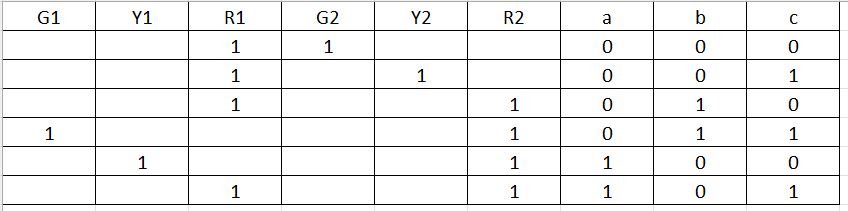
Task 1. Think about
how many
states the two-way traffic lights may have for each cycle.
The green light on one side truns yellow and then turns red
before
the other light changes to green from red. The last state is crossed
out because it repeats the first state.
This is a
practice on combinational logic, truth table, K-map, and logic
simplification. Show the code, code
explanation, and demo video in your report. (20 points) The regular
mode:
G1 =
Y1 =
R1 =
G2 =
Y2 =
R2 =
Task 2. While the first problem cycles through all states with the same
durations, during rush hours, the busy road has a longer duration for
the green light than the red light. Use a switch to trigger the
rush hour mode which keeps one of the green lights ON for double the
duration compared to the other road. Show the code, code explanation,
and demo video in your report. (20 points) The rush hour
mode:
The highlighted one is an added entry to keep the same state when the
input is incremented by one.
G1 =
Y1 =
R1 =
G2 =
Y2 =
R2 =
The demo video
Task 3. The entire system could be easily controlled by a Finite Sate Machine (FSM). The truth table only shows 6
different states. You can set up a 'reg' variable 'state' and direclty
send a 6-digit binary number to the 6 led traffic lights based on the
state. In this task, please use the FSM strategy to implement Task 1. (20 points)
Task
4. Add a second counter just for the state when G1 and R2 are both on
(rush hour mode for G1) to your FSM to implement the rush hour mode.(20 points)
Task 5. Add a switch to control your FSM rush hour mode. (20 points)